Mother Teresa, Saint Of Darkness
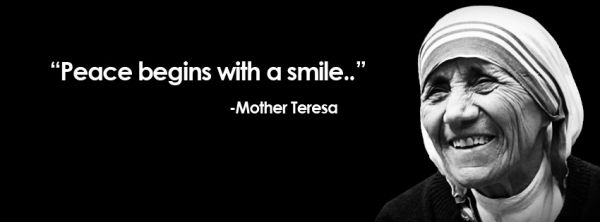
Every time someone mentions the word good deeds, saint, or service, one name that comes to mind is Mother Teresa. A noble peace prize winner and a mother to many homeless, poor and destitute people, Mother Teresa came from Albania.
After her father was killed, she was raised by
her mother, who invited beggars knocking at the door to dine with them. “Never
eat a single mouthful unless you are sharing it with others,” her mother said.
“Some of them are our relations, but all of them are our people.”

As a child she read the lives of the saints, and kept a map of the world on her wall, where she marked sites of missionary work. The Sacred Heart choir, in which she sang, made a pilgrimage to the Church of the Black Madonna, where she felt called to religious life.
At 18 she left for a convent in Ireland. The
sisters found her “very small, quiet and shy.” The next year she sailed to
Calcutta, staying in a convent of the Sisters of Loreto. She took the name
Teresa in honor of St. Thérèse of Lisieux, patron saint of missionaries.
On the train to Darjeeling, headed for a retreat
in the Himalayan foothills, she felt called to serve the poor, bringing dignity
to the lives of the dying, street children, and vagabonds. She thought of
Christ on the cross saying, “I thirst,” and felt this had a special meaning for
her, that he thirsted for the neglected to receive consolation. She wanted to
accomplish this for him.
 .
She left her quiet convent for the worst streets of Calcutta Instead of a nun’s habit, she wore a simple sari. Her first day in the slums she found a man dying alone in the street and gave him water. He was “so strangely grateful,” she wrote. She taught poor children to read by writing in the dirt with a stick, then followed them home to help their families.
.She left her quiet convent for the worst streets of Calcutta Instead of a nun’s habit, she wore a simple sari. Her first day in the slums she found a man dying alone in the street and gave him water. He was “so strangely grateful,” she wrote. She taught poor children to read by writing in the dirt with a stick, then followed them home to help their families.
Her former students began to join her. They
founded a home for the gravely ill called “Home of the Pure Heart,” where the
dying were soothed and given last rites according to their beliefs. She said,
“A beautiful death is for people who lived like animals to die like
angels—loved and wanted.” She founded a hospice for those suffering from
leprosy, “City of Peace,” and an orphanage, “Children’s Home of the Immaculate
Heart.”
When she received the Nobel Prize she said, “It
is not enough for us to say, ‘I love God, but I do not love my neighbor,’” and
declined the banquet in her honor, requesting the cost be donated to the poor.
Despite the apparent simplicity and fluidity of
her life - love of God translating directly into a life of service to the poor
- Mother Teresa had a dark secret. For fifty years she silently endured the
fear God had abandoned her. She no longer sensed his presence in her life,
feeling her soul was an “ice block.”
“When I try to raise my thoughts to Heaven-there
is such convicting emptiness that those very thoughts return like sharp knives
& hurt my very soul,” she wrote. “There is such terrible darkness within
me, as if everything was dead. It has been like this more or less from the time
I started ‘the work.’” “Tell me, Father, why is there so much pain and darkness
in my soul?” she asked.
Mother Teresa was not the first saint to
experience what to St. John of the Cross was a “dark night of the soul,” to St.
Ignatius Loyola, a “spiritual desolation,” and to St. Thérèse of Lisieux, a
“night of nothingness.” When theologian Joseph Neuner said it might help her understand
the abandonment felt by the poor she served, Mother Teresa wrote him, “I have
come to love the darkness.”
Jesuit priest James Martin wrote that decades of
her letters documenting the struggle with this darkness could be as significant
after her death as her service to the poor was during her life, lending
consolation to others who feel abandoned by God. “If I ever become a Saint—I
will surely be one of ‘darkness,’” wrote Mother Teresa. “I will continually be
absent from Heaven—to light the light of those in darkness on earth.”


Comments
Post a Comment